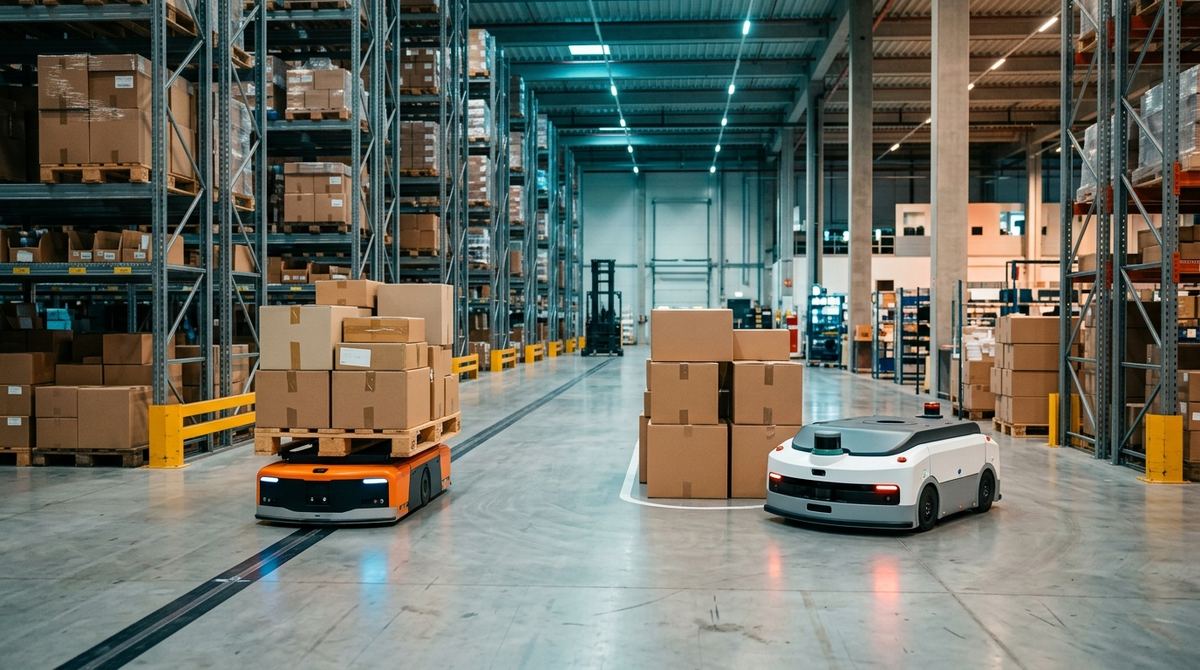
AGV and AMR are often used as synonyms, even by people selling them. They are not: behind the two acronyms sit two different navigation philosophies, with concrete consequences for infrastructure, installation time, flexibility and cost structure. Choosing the wrong one means, at best, paying for infrastructure that was never needed; at worst, ending up with a rigid system in a flow that changes every season. This guide lays out the real differences — with no cheering for either technology — and closes with a decision table to apply to your own plant.
The correct definitions
AGV — Automated Guided Vehicle: it follows a predetermined path, defined by guidance infrastructure. The classic technologies, in historical order: wire guidance (a wire buried in the floor), magnetic tape or spots, floor QR codes / tags, laser guidance with reflectors (the so-called LGVs, which triangulate their position on wall-mounted retroreflectors). The vehicle knows where it is relative to the path, not relative to the environment: if an obstacle blocks the trajectory, the AGV stops safely and waits for it to be removed.
AMR — Autonomous Mobile Robot: it builds and maintains a map of the environment through SLAM (Simultaneous Localization and Mapping) navigation, typically with lidar and/or vision, and localizes itself on the building's natural features: walls, racks, columns. The route is not wired anywhere: the robot plans it for each mission and re-plans it in real time, slowing down and driving around obstacles and people.
Technical honesty: the boundary is blurring. Many recent vehicles use natural-feature navigation but operate on constrained virtual paths, and some suppliers call them AGVs, others AMRs. To decide, the label does not matter: the questions in the table below do.
The differences that really matter
| Aspect | AGV | AMR |
|---|---|---|
| Required infrastructure | Wires, magnetic tape, tags or reflectors to install (and maintain) | No physical guidance; needs a map, Wi-Fi/network and charging points |
| Layout changes | Physical modification of the path: works and plant downtime | Re-mapping and new routes in software |
| Installation time | Weeks-months, with building works | Days-weeks, without significant works |
| Fleet scalability | Constrained by the capacity of the wired path | Vehicles added and managed by the fleet manager |
| Obstacles and people | Protective stop and wait | Slow-down, avoidance, re-planning |
| WMS/ERP integration | Project-specific, often proprietary | Modern APIs and emerging standards (VDA 5050) |
| Maintenance | Simple vehicle + maintenance of the guidance infrastructure | More complex vehicle (sensors, computing), no guidance infrastructure |
| Cycle predictability | Maximum: fixed trajectories and times | High but variable: depends on traffic in the area |
The last row deserves attention: AMR re-planning is an advantage in variable flows, but it introduces variability in cycle times. In a process synchronized to the second — for example line feeding at a fixed takt time — the absolute predictability of the AGV can be worth more than flexibility.
Safety: the standard is the same, the behaviour is not
On the regulatory side, industrial AGVs and AMRs both fall under ISO 3691-4 (industrial trucks — safety requirements and verification — part 4: driverless industrial trucks and their systems): person detection, protective fields of the safety laser scanners, speed management, protective stops, requirements for operating zones and confined areas. Risk assessment follows the general methodology of ISO 12100, and in North America AMRs have a dedicated reference in the ANSI/RIA R15.08 series. On the European market these vehicles remain machinery subject to CE marking, with the legislative framework transitioning from the Machinery Directive to Regulation (EU) 2023/1230, applicable from January 2027.
The practical point: safety does not depend on the acronym. It depends on vehicle compliance, on the quality of the integration and on the risk assessment of the real plant: intersections, doors, mixed human-vehicle areas, protruding loads. The behavioural difference nonetheless remains relevant to productivity in busy environments: where an AGV stops and waits, an AMR slows down and drives around. The impact of automation on reducing material-handling injuries is covered separately in AMRs and safety: reducing warehouse injuries.
When the AGV is still the right choice
- High-volume fixed flows: a few A→B routes repeated thousands of times, where flexibility is not needed and simplicity pays.
- Heavy or special loads: reels, coils, oversized loads: the heavy-duty LGV/AGV world is mature and proven.
- Controlled environments: areas with limited mixed traffic, where the protective stop is a rare event and not a bottleneck.
- Synchronized processes: line feeding at fixed takt, where cycle-time predictability is requirement number one.
- A greenfield designed around the routes: if the building is born with flows already optimized and stable for years, the guidance infrastructure amortizes comfortably.
When the AMR wins
- Variable flows: mission mixes, peaks, seasonality, e-commerce: dynamic re-planning is the structural advantage.
- Brownfield: existing plants where wires, tapes or reflector fields are impractical or too costly to install.
- Coexistence with people and vehicles: busy areas, where stopping at every interference would destroy productivity.
- Step-by-step growth: start with a few vehicles on one flow, extend in phases by adding robots — not infrastructure.
- Changing layouts: frequent reconfiguration of lines and areas: new routes in software, without works.
Costs: two different structures (before two different figures)
The correct economic comparison is not "which vehicle costs less", but where the cost concentrates. With an AGV the cost shifts to infrastructure and project engineering: route studies, installation works, commissioning; the vehicle itself is relatively simple. The hidden cost is the cost of change: every layout modification re-opens the construction site. With an AMR the cost concentrates in the on-board intelligence (sensors, computing, navigation software) and in the fleet software, often with licensed or subscription components; the required infrastructure is minimal and the cost of change is low. This produces very different payback profiles depending on the flows: the full economic analysis — TCO, payback and the variables that move them — is in the dedicated article ROI, TCO and payback of AMRs in intralogistics.
Decision table
| If in your plant... | Lean towards |
|---|---|
| Few fixed routes, very high repetitiveness, stable volumes | AGV |
| Variable flows, seasonal peaks, mission mixes | AMR |
| Existing building, no works possible on the floors | AMR |
| Very heavy or non-standard loads on dedicated routes | AGV (heavy-duty LGV) |
| Areas shared with people and moving vehicles | AMR |
| Line feeding at fixed, synchronized takt time | AGV |
| Phased growth, incremental budget | AMR |
| Layout reconfigured several times a year | AMR |
| Mixed flows: fixed backbones + variable distribution | Mixed AGV + AMR fleet (with a fleet manager and VDA 5050 interfaces) |
From the comparison to the choice on your plant
The real decision is not taken on a generic table but on your data: missions per hour, distances, load types, aisle widths, mixed traffic, the stability horizon of the layout, the WMS/ERP systems to integrate. On that basis the fleet is sized, the technology — or the combination — is chosen, and it is validated with a test on the most representative flow. PITECH represents in Italy Multiway robotic forklifts and AMRs and the goods-to-person solutions of the Scallog automated warehouse, within its industrial automation, robotics and material handling solutions: describe your flows via the contact page and set up an application evaluation together.
Frequently asked questions about AGVs and AMRs
What is the difference between an AGV and an AMR in one sentence?
An AGV (Automated Guided Vehicle) follows a predetermined path defined by guidance infrastructure — buried wire, magnetic tape, floor QR codes or laser reflectors — and stops and waits when it meets an obstacle. An AMR (Autonomous Mobile Robot) builds a map of the environment with SLAM navigation, localizes itself on the building's natural features, plans its own route and re-plans it in real time, driving around obstacles.
Is an AMR safe around people?
Yes, if compliant: both AGVs and AMRs fall under ISO 3691-4, the standard for driverless industrial trucks and their systems, which defines requirements for person detection, safety laser scanner protective fields, speeds, protective stops and warnings. AMRs add the ability to slow down and drive around instead of stopping. Real-world safety depends on the risk assessment of the specific plant (ISO 12100), not on the acronym.
Does the warehouse need modifications to install AMRs?
Generally not: AMRs navigate on the building's natural features and need no buried wires, magnetic tape or reflector fields. Some boundary conditions are still required: floors in reasonable condition, aisles of adequate width, Wi-Fi or dedicated network coverage, charging points and, when automating pallet flows, standardization of load carriers and pick/drop stations.
AGV or AMR for an existing (brownfield) warehouse?
In a brownfield the AMR starts with an advantage: it requires no building works, installs quickly, coexists with existing people and vehicles and adapts to layout changes in software. The AGV remains preferable even in existing plants when the flow is a few highly repetitive fixed routes, with heavy or special loads and limited mixed traffic: there, the simplicity of the fixed-path vehicle is an advantage.
Can AGVs and AMRs coexist in the same fleet?
Yes, and it is increasingly common: high-volume fixed flows on AGVs and variable flows on AMRs. The critical point is coordination: you need a fleet manager able to orchestrate different vehicles and a clean integration with WMS/ERP. The VDA 5050 interface standard was created precisely to let vehicles from different manufacturers talk to a single master control system.