The right question about an automated warehouse is not "how much does it cost", but "from which numbers onwards do my processes pay it back". It is a question that can be answered with a method, because manual picking has a known, measurable cost structure — and goods-to-person (G2P) automation attacks precisely its largest item: the time spent walking. This guide provides the reasoning thresholds to understand, before even talking to a supplier, whether your warehouse is a serious candidate: order lines per day, SKU count and rotation, labour cost, space, shifts. And it also states the opposite: the warehouse profiles where G2P is not the right answer.
What goods-to-person is and why it changes the picking equation
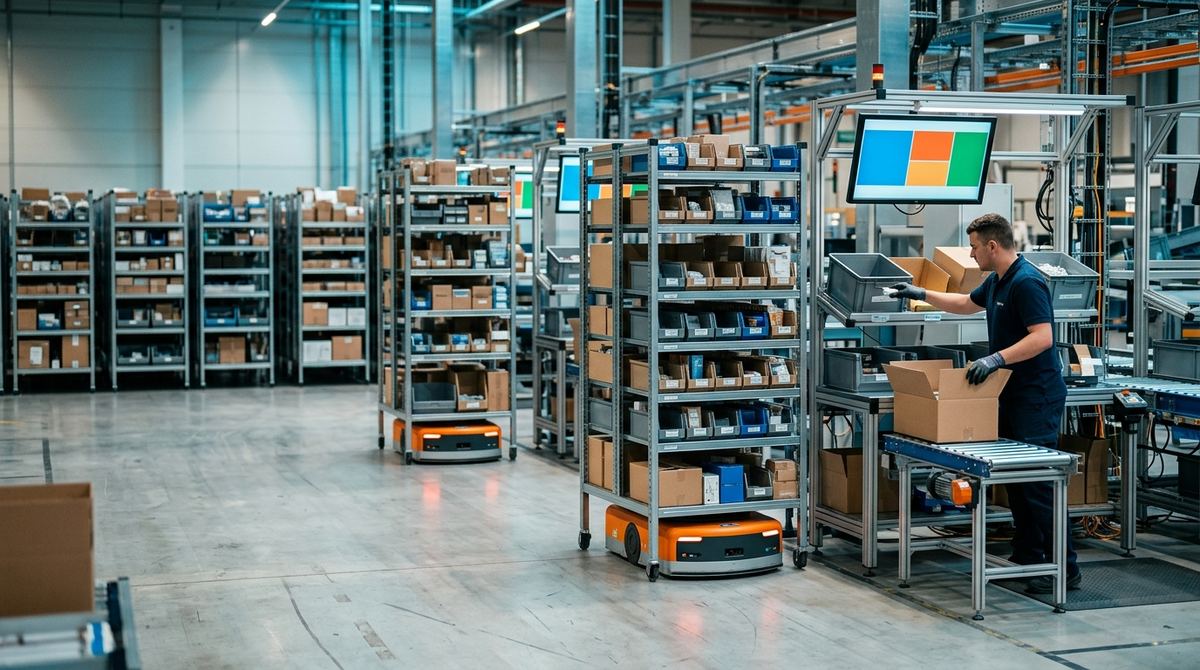
In a conventional warehouse the operator goes to the goods: walks the aisles, finds the location, picks, walks back. In a goods-to-person system the flow is inverted: mobile robots lift the shelves and bring them to picking stations, where the operator stays put and picks under software guidance. The difference is not cosmetic, it is structural: the scientific literature on order picking — the reference review is De Koster, Le-Duc and Roodbergen (2007) in the European Journal of Operational Research — estimates that picking accounts for up to about 55% of warehouse operating costs and that, in traditional picker-to-parts picking, travel is the dominant component, around half of the operator's time. G2P removes almost all of this component: that is why productivity per operator can multiply — for Scallog systems, the declared figure is picking up to ×3 — not by asking the operator to run faster, but by no longer making them walk kilometres.
The manual picking cost formula
The starting point of any serious evaluation is quantifying what picking costs today. The formula is elementary and uses only data the company already owns:
- Annual picking cost = number of dedicated operators × company hourly cost × hours/year.
- "Walking" share = annual cost × percentage of travel time (in the absence of your own measurements, the literature's order of magnitude is about 50%).
A generic numerical example, declared as such: a warehouse with 6 operators dedicated to picking on one 8-hour shift for 220 working days commits 10,560 man-hours per year; if about half is travel, the company pays every year for more than 5,000 hours of walking — the equivalent of two or three full-time employees whose job is, literally, walking aisles. This is the quantity G2P converts into picks: by multiplying productivity per operator, the same line volume is handled with fewer hours, or a growing volume is absorbed without adding people who cannot be found anyway. On top of this come picking errors (each error costs a return, a re-shipment, an unhappy customer), which display-guided picking with locations brought to the station structurally reduces.
The break-even thresholds: order lines, SKUs, rotation
The thresholds below are reasoning orders of magnitude, not rules: they serve to understand which zone you are in before sizing on real data.
| Order lines/day | Zone | Reasoning |
|---|---|---|
| Below ~150–200 | Hard to justify | Few picking hours can be saved: the annual saving struggles to repay the investment in acceptable time, except in cases with high space value or multi-shift needs |
| ~200–1,000 | Evaluation zone | The case depends on the other variables: labour cost, shifts, space, errors, expected growth. This is the band where sizing on real data decides |
| Above ~1,000 | Typically pays off | The volume of saved hours dominates the calculation; the real constraint often becomes finding operators, not paying them |
Lines alone are not enough: SKU count and rotation curve matter too. The ideal G2P profile is an assortment of hundreds to tens of thousands of small and medium-sized references with distributed rotation — the typical case of e-commerce, spare parts, cosmetics, electronics, pharma. With very few fast-moving SKUs the right goods are already always "in front of the operator" and a well-designed flow rack may be enough; with only slow movers, the walking hours that can be saved are few in absolute terms. It is the same principle as the ABC curve: G2P pays where the reference mix currently forces the operator into long, fragmented routes.
Space, shifts and seasonality: the payback multipliers
- Space: mobile shelves eliminate most walking aisles and compact storage: Scallog declares savings of up to 30% of space. Where the warehouse is saturated, this figure changes the calculation: postponing an extension or a second site, or freeing floor area for production, is often the single largest saving of all.
- Shifts: the investment is spread over operating hours. A system working two or three shifts accrues twice or three times the saved hours for the same invested capital: multi-shift operation is the most direct payback multiplier.
- Seasonality: at peaks, a manual warehouse hires seasonal staff to be trained in a hurry, with worse productivity and errors exactly when volume is highest. A modular G2P adapts by adding robots to the fleet, not people: scalability is an insurance policy on the peak — hard to quantify in advance, very concrete in November.
The evaluation path: data, sizing, payback
A professional evaluation requires few data points, but the right ones:
- Order lines per day, with hourly and seasonal profile (a 12-month export from the ERP is the ideal basis);
- SKU master data: number of references, item dimensions and weights, ABC rotation curve;
- Floor plan of the warehouse with usable heights and constraints (columns, docks, served areas);
- Information systems: WMS or ERP in use and integration points;
- Organization: dedicated operators, shifts, overtime and seasonal staff at peaks.
On this basis the supplier sizes the robot fleet, shelves and stations, and the payback is calculated with a method, not promised: total investment (system + integration + training) divided by annual savings, where the savings add up picking hours saved × hourly cost, the value of recovered space, error reduction and lower use of overtime and seasonal staff. A specific advantage of mobile-shelf G2P is the implementation profile: standard Scallog systems are installed in 2–3 weeks, because the robots navigate on optical floor guides and no civil works or bolted structures are needed — which reduces both project risk and operational downtime. The criteria for comparing the different automation technologies are covered in depth in the guide how to choose an automated warehouse.
When it does NOT pay off: the wrong profiles
Technical honesty on this point is worth more than any brochure. Mobile-shelf G2P is not the right answer when:
- there are too few lines: below the indicative threshold of 150–200 lines/day, the hours saved rarely justify the investment — better to optimize routes, slotting and batching of manual picking;
- items are oversized or very heavy: the system works with items that fit in the compartments and within the mobile shelf's payload limit (600 kg for Scallog's Boby robot): full pallets, long or heavy items require robotic forklifts and pallet-moving AMRs or conventional solutions;
- the assortment is a handful of fast movers: if 90% of the lines fall on a few dozen references, a flow rack or a well-designed pick zone delivers most of the benefit at a fraction of the cost;
- the flow is dominated by full pallets in and out: there the issue is transport, not picking: the right evaluation is the one for AMR ROI and TCO.
Very often the correct answer is hybrid: G2P for fast-moving small items, transport technologies for pallets, conventional racking for bulky slow movers.
G2P vs conventional racking vs miniload: the conceptual comparison
| Criterion | Conventional racking | Goods-to-person (mobile shelves) | Miniload / AS/RS |
|---|---|---|---|
| Picking productivity | Baseline (dominated by walking) | High: operator fixed, goods brought to station | High, tied to fixed mechanics |
| Initial investment | Minimal | Intermediate, modular | High, structural |
| Implementation time | Immediate | Weeks (2–3 for standard Scallog systems) | Months, with civil works |
| Scalability | Adding people | Adding robots and shelves | Rigid: sized at the outset |
| Layout reversibility | Total | High: no heavy fixed structures | Low |
| Ideal profile | Low volumes, heterogeneous items | Many lines on a medium-to-wide assortment of small/medium items | Very high, constant volumes on standard totes |
The next step: from your numbers to a sizing exercise
If your lines per day, assortment and space constraints place your warehouse in the evaluation zone, the next step is not a generic quote: it is a sizing exercise on real data. PITECH represents in Italy the Scallog goods-to-person systems — a consolidated technology with 80 installations in 10 countries and 2,000 robots in the field, picking up to ×3, reverse logistics up to ×8 and 2–3 week installation for standard systems — within its industrial automation and robotic material handling solutions. The evaluation starts from your data (lines/day, SKUs, floor plan, WMS) and returns a sizing with the payback calculation method made explicit — including, where appropriate, the honest advice that G2P is not the right solution for your profile. For a preliminary comparison between technologies, the guide AGV vs AMR is also useful. To start the evaluation, describe your warehouse via the contact page.
Frequently asked questions on automated warehouse viability
How many order lines per day does a goods-to-person warehouse need to pay off?
As an indicative order of magnitude: below 150-200 lines per day the investment is hard to justify on productivity alone; between 200 and 1,000 lines you enter the evaluation zone, where the outcome depends on labour cost, shifts, space and errors; above 1,000 lines per day the case is typically clear-cut. These are reasoning thresholds, not rules: the real number comes from sizing on actual data (hourly line profile, SKU ABC curve, seasonality).
How much space does a goods-to-person automated warehouse save?
A goods-to-person system such as Scallog declares storage space savings of up to 30% compared with conventional walk-and-pick racking: mobile shelves eliminate most walking aisles and the goods are compacted. The actual saving depends on the starting layout: it is quantified during sizing on the floor plan.
How long does the installation of a goods-to-person system take?
For standard Scallog systems, installation takes 2-3 weeks: the robots navigate on optical floor guides and no heavy civil works or bolted fixed structures are needed, unlike a miniload or a traditional AS/RS. The overall project (data analysis, sizing, WMS integration, training) takes longer than the physical installation and is the part that determines the result.
Does goods-to-person pay off with heavy or oversized items?
No, and it is worth saying clearly: mobile-shelf goods-to-person works with items that fit in the shelf compartments and within the robot's payload limit (600 kg per shelf for Scallog's Boby robot). Oversized, very heavy or full-pallet flows require other solutions: robotic forklifts, pallet-moving AMRs or conventional pallet warehouses. Often the right answer is hybrid: G2P for fast-moving small items, other technologies for the rest.
How is the payback of an automated warehouse calculated?
With a method, not a promise: payback = total investment divided by annual savings. Annual savings add up the picking hours saved multiplied by the company hourly cost (productivity per operator in a G2P can triple, Scallog figure), the value of the space recovered (up to 30%), the reduction of picking errors and the costs they generate, and any reduced use of overtime and seasonal staff at peaks. The investment includes the system, WMS integration and training. The number is credible only if calculated on the warehouse's real data.