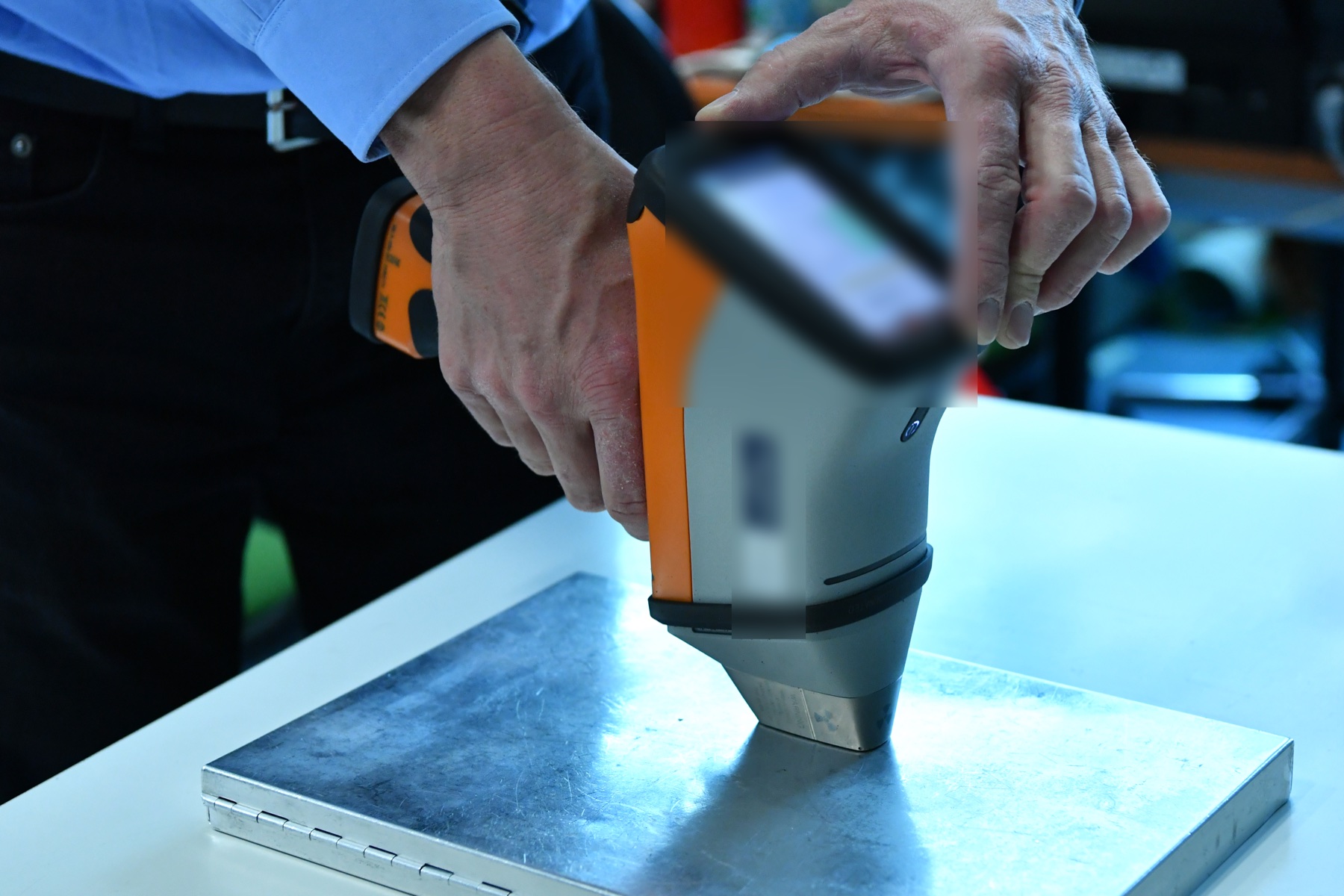
Anyone looking for a portable XRF analyzer for mining almost always has one element in mind: copper in a drilling campaign, zinc and lead on a development face, iron and silica in a limestone quarry, arsenic in a soil that needs characterising. The first check concerns that element, at that concentration, in that rock. For many metals the instrument delivers a result in a minute, in the field. For some light elements it can, under specific conditions. For gold at deposit grades, lithium and boron it can't. Bruno Lemière's review in the Journal of Geochemical Exploration (2018) describes portable X-ray fluorescence as a core method of field geochemistry, because it moves decisions from the laboratory to the ground.
Which elements portable XRF reads in a rock, and which ones it misses
Physics sets the boundary. Every element re-emits photons at a characteristic energy, and the lighter the element, the lower that energy. According to the X-Ray Data Booklet of Lawrence Berkeley National Laboratory, the Kα line sits at about 1.25 keV for magnesium, 1.49 for aluminium, 1.74 for silicon, 2.01 for phosphorus and 1.04 for sodium, energies largely absorbed by air and by the instrument window. For lithium, beryllium, boron and carbon they drop to a few hundred electronvolts or less, and portable measurement isn't feasible. US EPA Method 6200 (Revision 0, February 2007) stated that the field portable instruments of the time could not detect any element up to phosphorus. Since then, silicon drift detectors (SDD), with short optical paths and helium purge or vacuum, have brought magnesium, aluminium, silicon and phosphorus within reach, with higher detection limits than for metals and longer measurement times. Sodium stays at the margin.
For metals the picture is better, though not uniform. In the study sponsored by the Canadian Mining Industry Research Organisation (CAMIRO) and published by Hall, Bonham-Carter and Buchar in Geochemistry: Exploration, Environment, Analysis (2014), five instruments each measured 41 pulp certified reference materials ten times, using factory calibration. Major elements were well determined, except magnesium. Arsenic, copper, lead, rubidium and strontium landed in the best class, gold, mercury, tungsten and palladium in the worst. Instruments have improved, but the ranking depends on physics and interferences and remains a useful reference. The lead Lα line and the arsenic Kα line both fall around 10.5 keV, so a lead-rich soil can report arsenic that isn't there. The zinc Kβ line overlaps the gold Lα line.
Gold also has a problem of scale. Deposit grades are measured in grams per tonne, that is, parts per million, where portable instruments don't give reliable numbers. In gold exploration, XRF works on pathfinder elements such as arsenic, copper or antimony, and the gold grade is left to fire assay. As for detection limits, the EPA method publishes example values obtained on clean quartz sand with count times of 100 to 600 seconds, warns that they may not be achievable in the field, and asks for limits to be established on the real matrix with certified reference materials.
Do you have a specific mineral or element to measure?
Send us the elements, the sample type and the expected concentrations: we'll tell you whether portable XRF is suitable and which configuration you need. Quote within 24 hours.
Mining, soil or alloy mode: three calibrations for three different questions
The same instrument can give different numbers on the same sample depending on the mode selected. Alloy mode, also used for material verification in foundries, normalises the sum of the elements and looks up the grade in a library. On a rock, made mostly of oxygen and elements the instrument can't see, it produces inflated concentrations. The EPA method describes the calibration families behind geochemical modes: fundamental parameters (FP), calculated from physics without site samples; empirical calibration on site standards; and normalisation to the Compton peak, the radiation scattered by the sample, which compensates for matrix variation. In manufacturers' practice, soil mode uses Compton normalisation and performs well on traces in ppm, while mining mode uses fundamental parameters and reaches major elements at percent levels.
Neither is ready to use straight out of the factory. In the CAMIRO study, slopes between measured and certified values ranged from 0.5 to 5.0: for some elements the instrument read half the true value, for others five times it, and the authors concluded that user calibration is needed in both modes. The mode is chosen on the sample, not on the brochure.
On the outcrop, on the core or in the cup: preparation decides the error
According to the EPA method, instrument precision is usually the smallest part of the total error; sample-related error weighs more. Measuring on an outcrop is the fastest and least representative option. The instrument reads a spot a few millimetres across and, for light elements, a very thin layer, so weathering rind, oxide coatings and moisture end up in the result. On a coarse-grained rock, one galena crystal under the window is enough to skew the reading. Fresh surfaces and several averaged readings are needed. On drill core, measure the cut, dry face at regular intervals and record the depth, so the reading can later be compared with the laboratory assay of the same interval.
Powder in a cup comes closest to the laboratory. The sample is dried, ground, sieved to 60 mesh (0.25 mm) as EPA specifies, and closed in the cup with a thin film. The same method treats moisture between 5 and 20% as a minimal effect and saturated samples as a major error source, to be dried in a convection oven, not a microwave. Ravansari, Wilson and Tighe, in a 2020 review in Environment International whose title warns that pXRF is "not just a point and shoot method", single out water and organic matter as the most insidious interferences. The film matters too: in the CAMIRO study, 4 µm polypropylene transmitted magnesium, aluminium and silicon better than polyester.
Matrix effects and certified reference materials: where a reliable number comes from
The matrix remains. Nickel fluorescence has an energy just above the iron absorption edge, so nickel in an iron-rich laterite measures differently from nickel at the same grade in a granite. Fundamental parameters correct these effects by making assumptions about the invisible part of the sample, meaning oxygen, carbonate carbon and structural water, and a wrong assumption becomes a systematic error. The remedy is a type calibration on certified reference materials (CRMs) with a similar matrix and on site samples already assayed in the laboratory, with correction factors derived element by element. A CRM is only as good as its certificate: ISO 17034:2016 sets the competence requirements for producers, and it's the first thing to check.
Duplicates, blanks, CRMs and the lab: the quality control that makes data defensible
Portable data without quality control is an impression. EPA Method 6200 describes a routine designed for soils that also works in exploration. Its thresholds are guidance, and each project can set its own:
- a check sample at the start, middle and end of the day, within ±20% of the true value; otherwise recalibrate and re-run the batch;
- one precision sample per day measured 7 times, with relative standard deviation within 20% (30% for chromium);
- a blank at least once a day;
- at least 1 sample in 20 sent to the laboratory for confirmation, across low, medium and high grades;
- regression between portable and laboratory results, on log-transformed data if grades span more than one order of magnitude.
With a correlation coefficient r of at least 0.7, portable data qualify as screening data. With r of 0.9 or more and statistical equivalence at 99% confidence, EPA says they could approach definitive-level data. A sizing example, based on our own assumptions: 400 soil samples measured in cups at 60 seconds per reading, the trade-off reported by the CAMIRO study, need at least 20 laboratory confirmations plus one CRM and one blank per day. If copper correlates at r = 0.95 and arsenic at r = 0.6, copper can guide drill targets while arsenic remains a qualitative indicator.
JORC and NI 43-101: what pXRF data are worth in a mining report
For market announcements, the JORC Code, 2012 Edition, mandatory from 1 December 2013, explicitly mentions handheld XRF instruments in Table 1. It asks for make and model, reading times, calibration factors and their derivation, the quality control adopted (standards, blanks, duplicates, external checks) and acceptable levels of accuracy and precision. In Canada, National Instrument 43-101, in its 30 June 2011 version amended to 2023 and under review since 2025, requires in Form 43-101F1 an Item 11 on sample preparation, analyses and security and an Item 12 on data verification.
Neither code prohibits portable data. Both require them to be documented and the responsible professional (the Competent Person under JORC, the Qualified Person under NI 43-101) to stand behind them. In practice pXRF guides sampling, mapping and production control, while resource estimation rests on laboratory assays, with portable data used only where a documented correlation supports them. For a project headed for a public report, the QA/QC protocol has to be in place from day one.
Exploration, grade control, quarries and soils: where the instrument pays off
In exploration, a portable analyzer shortens the cycle between sampling and decision. A soil grid is measured within the day, and drill targets are adjusted while the crew is still on site. In mining it serves grade control, separating ore from waste on blast-hole cuttings, faces or stockpiles, with a correlation verified on the deposit. In quarries and industrial minerals, major elements and impurities count, such as iron in silica sands or the calcium-to-magnesium ratio in limestones and dolomites, and here magnesium and silicon make an SDD with helium or vacuum the deciding choice.
For contaminated soils, ISO 13196:2026, the second edition, adopted in Europe as EN ISO 13196:2026 (we haven't verified national adoptions), treats soil screening with portable ED-XRF as a qualitative or semi-quantitative measurement that guides sampling for the laboratory, with validation for As, Cd, Co, Cr, Cu, Hg, Mo, Ni, Pb, Sb, Sn, V and Zn. Universities also use it on a bench stand, and as early as 2005 the IAEA-TECDOC-1456 report listed mineral exploration among the reference in situ applications. If value is driven by gold at a few grams per tonne, lithium in a pegmatite or boron, the portable instrument can at most measure associated elements: for light elements see the comparison of LIBS and XRF, and for gold in alloys the article on XRF analysis of gold and precious metals.
Si-PIN or SDD, tube voltage, filters and battery: how to read a configuration
The detector outweighs every other item. A Si-PIN detector is enough for transition and heavy metals at concentrations that aren't too low. An SDD counts many more photons at better resolution, separates neighbouring lines, shortens measurement times and, with helium or vacuum, reaches magnesium, aluminium, silicon and phosphorus. For geochemistry, with traces and complex matrices, it's today the reference choice. Tube voltage decides which lines are excited: for K lines it must exceed the element's edge, about 25.5 keV for silver, 29.2 for tin and 37.4 for barium according to the X-Ray Data Booklet. Below that, only the L lines remain, weaker and exposed to overlaps such as barium on titanium. In the field, battery life against the real duty cycle, IP rating, GPS, a camera and software that exports data with coordinates and sample ID all count.
Radiation protection remains. In Italy, using an analyzer with an X-ray tube falls under Legislative Decree 101 of 31 July 2020: as a rule, the practice notification under Article 46 is required at least thirty days before operations start, with an assessment by a radiation protection expert and operator training. If the instrument goes to another country, licensing and import follow that country's rules and are the importer's responsibility, to be checked with the local authority before ordering.
Portable, benchtop or laboratory: how to decide
| Aspect | Portable XRF | Benchtop XRF | Laboratory (ICP, fire assay) |
|---|---|---|---|
| Preparation | None, or sieved powder in a cup | Pressed pellet or fused bead | Digestion or fusion; fire assay for gold |
| Elements | From Mg upwards with SDD and helium or vacuum; no Li, B, C | Wider range, light elements measured better | Almost the whole periodic table, Li included |
| Time to result | Seconds to minutes | Minutes, plus preparation | Days |
| Typical use of the data | Screening, mapping, grade control | Process control, routine assays | Resource estimation, contracts, certification |
If you need to decide on site where to sample, which interval to send to the laboratory or whether a stockpile is ore or waste, portable XRF is the right tool and pays off in decisions brought forward. If the data must support a resource estimate or the sale of a concentrate, the laboratory remains the reference: for iron ores ISO 9516-1:2003 describes wavelength-dispersive X-ray fluorescence on fused beads, and for gold and silver in copper, lead and zinc concentrates ISO 10378:2016 specifies fire assay. Available configurations are on the page dedicated to XRF and PMI material analysis, general criteria in the guide on how to choose a portable XRF analyzer, and investment factors in the article on what drives the cost of an XRF analyzer.
What to send us for a quote
The fastest way to find out whether portable XRF solves your case is to send us the details of the problem. With this information we assess the configuration for your case and prepare a quote within 24 hours:
- elements to measure and expected concentration ranges, in ppm or percent, flagging those that determine value or compliance;
- sample type: outcrop, drill core, drill cuttings, powder in a cup, soil, concentrate;
- working environment: field campaign, open-pit or underground mine, quarry, laboratory, with temperature, dust and humidity;
- number of measurements per day and time available for each;
- reporting requirements: data export, GPS, format for the geological database, JORC or NI 43-101 protocols;
- country of use and number of instruments.
A few lines are enough: we'll reply with the recommended configuration and a quote within 24 hours.
The final criterion comes down to two conditions. Portable XRF pays off when your element is visible to fluorescence at the grades you care about, and when a result in one minute changes a decision that currently waits for the laboratory. If either is missing, the laboratory remains the cheaper choice, and we'll say so plainly. If both are met, the next step is to define the configuration on your samples and your volumes.
Frequently asked questions about portable XRF for mining
Can portable XRF measure gold in ore?
Not at deposit grades. Gold in ore is measured in grams per tonne, that is parts per million, and at those levels portable instruments don't give reliable numbers; the zinc Kβ line also overlaps the gold Lα line. In exploration, pathfinder elements such as arsenic, copper or antimony are measured, while the gold grade is determined in the laboratory by fire assay.
Which light elements can a portable XRF analyzer measure?
With an SDD detector and helium or vacuum measurement, magnesium, aluminium, silicon and phosphorus can be measured, with higher detection limits than metals and longer times. Sodium stays at the margin, measurable only at high concentrations under favourable conditions. Lithium, beryllium, boron and carbon can't be measured by portable X-ray fluorescence.
What is the difference between mining, soil and alloy mode?
Alloy mode is designed for metals and normalises the composition to 100%, so on a rock it gives meaningless results. Soil mode usually relies on Compton normalisation and performs well on traces in ppm; mining mode uses fundamental parameters and also covers major elements up to percent levels. Both must be checked and corrected with certified reference materials matching the sample matrix.
How do you prepare a rock sample for portable XRF analysis?
Direct measurement on rock needs a fresh surface and several averaged readings per point. On drill core, measure the cut, dry face and record the depth. For the best results the sample is oven-dried by convection, ground, sieved (EPA Method 6200 specifies 60 mesh, 0.25 mm) and measured in a closed cup with a thin film.
Can portable XRF data be used in a JORC or NI 43-101 report?
Yes, provided they are documented. The JORC Code 2012 requires disclosure of instrument, reading times, calibration factors and quality control; Form 43-101F1 requires a description of sample preparation, analyses, security and QA/QC. In practice pXRF data guide sampling and grade control, while resource estimation relies on laboratory assays unless a documented correlation supports the portable data.
Are permits needed to use or export a portable XRF analyzer?
In Italy the analyzer contains an X-ray tube and its use falls under Legislative Decree 101/2020, which as a rule requires a practice notification at least thirty days before operations start, an assessment by a radiation protection expert and operator training. For use in another country, that country's rules apply and are the importer's responsibility, to be checked with the local authority before ordering.