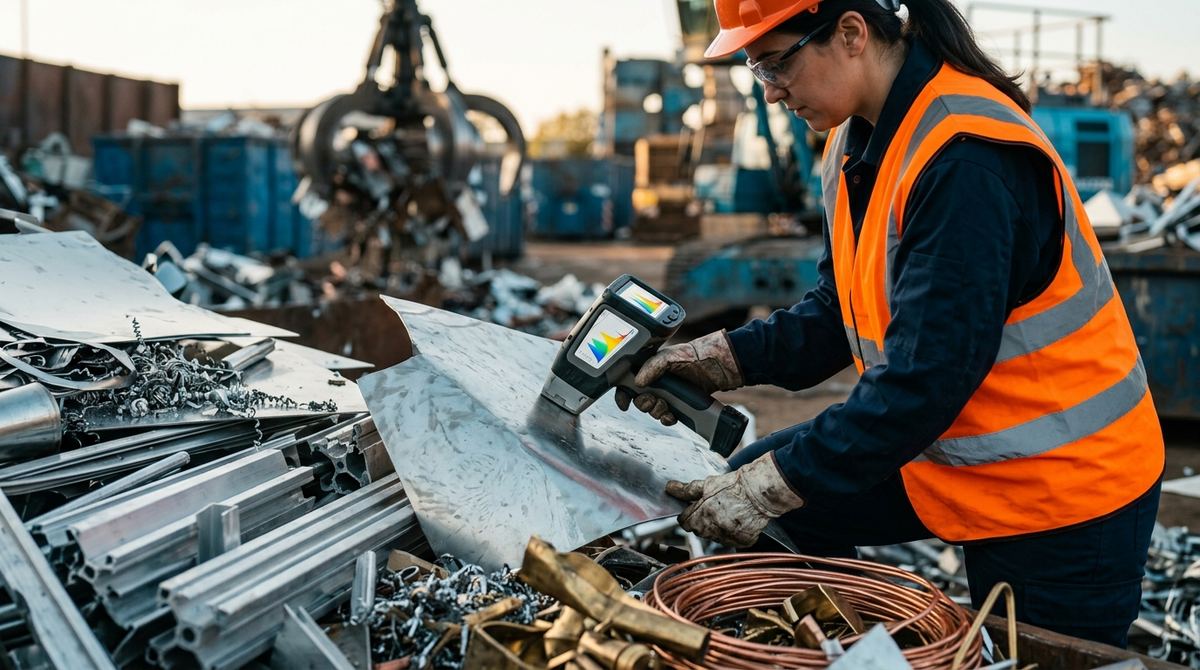
In the scrap metal trade, value is not in the weight: it is in the composition. The same kilogram of "stainless" can be worth very different money depending on whether it is a 304, a 316 or — more often than people think — a nickel alloy that ended up in the wrong pile. Whoever buys and sells scrap without identifying the alloys is working blind: paying the declared grade's price for material that was never verified, and selling at the poorest grade's price what was never separated. Handheld XRF analysis is the tool that changed this equation: alloy identification in a few seconds, directly in the yard, with no sample preparation. This guide explains how it works, where it delivers the most, where it does not reach, and how to set up a workflow that turns sorting into margin.
Why alloy identification is the core of the recycling business
Scrap is priced by family and by grade: austenitic and ferritic stainless steels, nickel alloys, titanium, copper and its alloys, aluminium by series. The value differences between neighbouring grades are large and come from the valuable alloying elements: the molybdenum that separates a 316 from a 304, the nickel and chromium of superalloys, the vanadium and aluminium of titanium alloys. Three practical consequences:
- A mixed load is paid as its poorest component. Sorting by grade before selling means selling each fraction at its own price, not at the worst one's.
- Buying without verifying means accepting downgrade risk. Incoming inspection with XRF, sample-based or systematic, protects against receiving material different from what was declared.
- The ability to certify sorting makes you a "premium" supplier. Steel mills and foundries pay better for homogeneous, documented lots, because these reduce their risk of melt contamination (think of copper or tin in steels). The European framework points the same way: Council Regulation (EU) No 333/2011 on end-of-waste criteria for iron, steel and aluminium scrap requires quality management systems and documented checks on the material.
How handheld XRF works in the scrap yard
X-ray fluorescence (XRF) is an elemental analysis technique: a miniaturized X-ray tube irradiates the part, the excited atoms re-emit "characteristic" X-rays with element-specific energies, and a solid-state detector (today typically an SDD, Silicon Drift Detector) reconstructs the spectrum and converts it into a percentage composition. Three properties make the technique ideal for scrap:
- Speed: on common alloys the result arrives in 1–5 seconds; the instrument compares the composition against an alloy grade library and returns the grade name with its match index directly, not just a table of percentages.
- No preparation for triage: you measure by resting the instrument window on the part, whatever its shape. No sampling, no waiting for a laboratory.
- Non-destructive: the part stays intact and sellable; you can take as many readings as needed, at different points, and save them with photos and lot references.
The grade libraries of the best instruments cover hundreds of grades (AISI/UNS, EN, trade designations) and are customizable: operators working specific niches — aerospace superalloys, foundry alloys — can add their own grades and acceptance thresholds. For general selection criteria of a handheld instrument, see the dedicated guide: how to choose a portable XRF analyzer.
The applications that generate margin
| Application | What XRF does | Business impact |
|---|---|---|
| Stainless sorting | Separates 300/400 series, 304 vs 316 (via Mo), duplex grades | Each fraction sold at its right price |
| Nickel alloys and superalloys | Identifies Ni-Cr and Ni-Cu alloys (625, 718, 400 families...) | Highest-value pieces recovered from the pile |
| Titanium and its alloys | Separates commercially pure Ti from Ti-6Al-4V and other alloys | Value recovery on aerospace and medical offcuts |
| Machining offcuts and turnings | Verifies homogeneity of lots from workshops and foundries | Certified lots, fewer downstream disputes |
| Incoming load control | Sample-based verification of the supplier's declared grade | Protection against downgrades at purchase |
| Outgoing load control | Documented composition of the lot being sold | Better price, trust from mills and foundries |
| Dispute management | Objective, stored, repeatable data on contested material | Disputes closed with evidence, not opinions |
On aluminium the picture is more nuanced: XRF separates well the series alloyed with zinc, copper and manganese, while for the magnesium- and silicon-based series (5xxx, 6xxx) light-element sensitivity is the limiting factor and the latest instruments, or LIBS technology, make the difference. A separate case, with its own logic, is precious metals: we cover it in the dedicated article on XRF analysis of gold and precious metals.
The limits of XRF on scrap: knowing them is part of the trade
- Light elements: in air, handheld XRF does not detect elements lighter than magnesium (Z < 12): lithium, beryllium, boron, carbon, nitrogen, oxygen. Magnesium, aluminium and silicon can be measured, but with reduced sensitivity compared with heavy elements.
- Carbon: the direct consequence: XRF cannot sort carbon steels by carbon content and cannot distinguish a 304 from a 304L. Where carbon decides value or compliance, you need LIBS technology or the laboratory: the full comparison is in LIBS vs XRF for carbon.
- Dirty, painted, coated surfaces: XRF analyses a few microns to tens of microns of depth. Oil, soil, paint, galvanizing and thick oxidation distort the reading; claddings are measured instead of the base metal. The countermeasure is simple: grind a small spot down to bare metal before the readings that matter.
- Difficult geometries: thin wires, fine turnings, parts smaller than the measurement window only partially fill the analysed volume: results must be interpreted, and it pays to average several readings or compact the material.
The recommended workflow in the yard
- Preliminary triage: visual separation, magnet for the ferrous fraction, rough density checks where useful. It costs little and reduces the number of XRF measurements needed.
- XRF analysis: a fast reading for grade assignment; for valuable or doubtful pieces, a ground spot and 2–3 readings on different areas. Results stored with photos and lot references.
- Laboratory confirmation when needed: for high-value lots, formal disputes or contractual requirements, sampling and OES or wet-chemistry analysis (carbon and sulphur by combustion). XRF settles 95% of cases in seconds; the laboratory closes the remaining 5% with defensible weight.
The underlying logic is the one codified in ASTM E1476 (Standard Guide for Metals Identification, Grade Verification, and Sorting): fast methods for mass sorting, reference methods for critical decisions, and traceability of the results. The same principle applies, at the opposite end of the chain, to incoming material control in manufacturing: we cover it in the guide to metal material traceability and PMI.
How to choose an instrument for yard use
- Ruggedness: dust, rain, knocks and drops are the norm: IP rating, measurement-window protection and operating temperature range all matter.
- Real speed: SDD detector, high-count-rate electronics and grade-match algorithms determine the time to a reliable result, which is the right metric (not the shortest declared measurement time).
- Grade library: breadth, upgradability, the ability to add your own grades and to set match thresholds on critical elements.
- Battery life: hot-swappable batteries and full-shift capacity; the yard has no power sockets.
- Ergonomics: weight and balance (thousands of readings per day), a comfortable trigger, a display readable in full sun, use with gloves.
- Data management: stored readings with photos and notes, export, connectivity to attach results to load documents: this is what turns a measurement into lot certification.
- Service and calibration: periodic checks with certified reference samples and a fast service channel: a stopped instrument is a yard sorting by eye.
Radiation safety and safe use in Italy
Modern handheld XRF analyzers use an X-ray tube, not radioactive sources: they are therefore generators of ionizing radiation, and their use in Italy is a practice regulated by Legislative Decree 101/2020, implementing Directive 2013/59/Euratom. In practice: depending on how the practice is classified, administrative steps apply (notification or license), together with a prior assessment by a qualified radiation protection expert and operator training. Operationally, the beam is collimated, shielded and active only while the trigger is pressed, often with sample-proximity sensors: with correct procedures — never point the instrument at people, never hold small parts in your hand during close-up measurements — the risk is thoroughly manageable. A serious supplier includes support on these compliance steps in the supply, instead of leaving the customer to discover them after delivery.
From the pile to the margin: the next step
The right choice starts from the materials that actually cross your yard: alloy families, volumes, average lot value, whether or not carbon must be measured. On that basis you can decide whether XRF is enough, whether to add a LIBS analyzer, and which configuration (library, accessories, data management) pays best. PITECH distributes in Italy Elvatech handheld XRF analyzers and LANScientific PMI LIBS analyzers, within its XRF and PMI material analysis solutions, and supports the evaluation with tests on your real samples: describe your application via the contact page.
Frequently asked questions about XRF analysis of scrap metal
How much does an XRF analyzer for scrap cost?
The price depends on configuration, elements to measure and accessories. PITECH provides a tailored quote within 24 hours and can arrange a test on your own material, at no obligation. Request a price or message us on WhatsApp.
How fast and reliable is XRF analysis of scrap metal?
On common alloys (stainless steel, nickel alloys, titanium, copper) a modern handheld XRF analyzer with an SDD detector identifies the grade in a few seconds, with no sample preparation for triage. Reliability depends on the cleanliness of the measured spot, part geometry and the quality of the grade library: on dirty, painted or coated surfaces it pays to grind a small spot before measuring.
Can XRF tell 304 stainless from 316?
Yes, and it is one of the most profitable applications in recycling: 316 contains roughly 2-3% molybdenum, an element XRF measures very well, while 304 has none. Separating 304 from 316 takes a few seconds. What XRF cannot do is distinguish the low-carbon variants (304 vs 304L): carbon is not measurable by XRF and requires LIBS or laboratory analysis.
Which elements can XRF not see on scrap?
Handheld XRF in air does not detect elements lighter than magnesium: lithium, beryllium, boron, carbon, nitrogen and oxygen remain invisible; magnesium, aluminium and silicon are measurable but with reduced sensitivity. That is why XRF cannot sort carbon steels by carbon content and cannot distinguish L grades: for carbon you need LIBS technology or laboratory analysis (OES, combustion).
Do I need an authorization to use a handheld XRF analyzer in Italy?
Yes: XRF analyzers with an X-ray tube are generators of ionizing radiation and their use falls under the practices regulated in Italy by Legislative Decree 101/2020, implementing Directive 2013/59/Euratom. Depending on how the practice is classified, administrative steps (notification or license), an assessment by a qualified radiation protection expert and operator training are required. A serious supplier guides you through these steps before delivery.
Does the scrap surface need preparation before an XRF measurement?
For fast triage often not: you measure directly on the part. But XRF analyses only a few microns to tens of microns of surface: dirt, oil, paint, galvanizing, oxidation and cladding distort the result. For high-value decisions (nickel-alloy or titanium lots, disputes) the correct practice is to grind a small spot down to bare metal and take several readings at different points.